
LM270WF7-SLA1 sourcing should establish whether production HMI pages remain readable from the equipment's intended operating positions. Moving an existing FHD interface onto a 27-inch panel makes fixed pixel elements physically larger, but does not add information capacity. Purchasing needs evidence that operators can distinguish the required values, labels, and alarms without moving closer than the equipment permits.
Claim: A 27-inch diagonal becomes a purchasing advantage only when the required information is readable at the intended workstation.
What Does 27-Inch FHD Change on an OEM HMI?
How Large Is the Smallest Required Character?
LG Display's available Ver.0.1 preliminary specification, dated 15 June 2016, identifies 1920 × 1080 pixels and 0.3114 mm pixel pitch. This corresponds to a 597.888 × 336.312 mm active image. XIANHENG's product page cites Ver.0.4 dated 12 September 2016; that complete document was not available for this review. Obtain the applicable SLA1 specification before design release.
Inspect the rendered glyph, not just the font-size setting or text-box height. With one source pixel mapped to one panel pixel, visible character height equals its pixel height multiplied by pixel pitch.
| Illustrative rendered glyph height | Calculated physical height |
|---|---|
| 12 pixels | 3.74 mm |
| 18 pixels | 5.61 mm |
| 24 pixels | 7.47 mm |
These examples are not recommended minimums. A larger FHD panel enlarges the same pixel canvas; it cannot add detail to a low-resolution inspection image or extra rows to a fixed alarm list.
Claim: Specify the physical size of required information rather than treating FHD resolution as proof of legibility.
From Which Positions Must Operators Read the Screen?
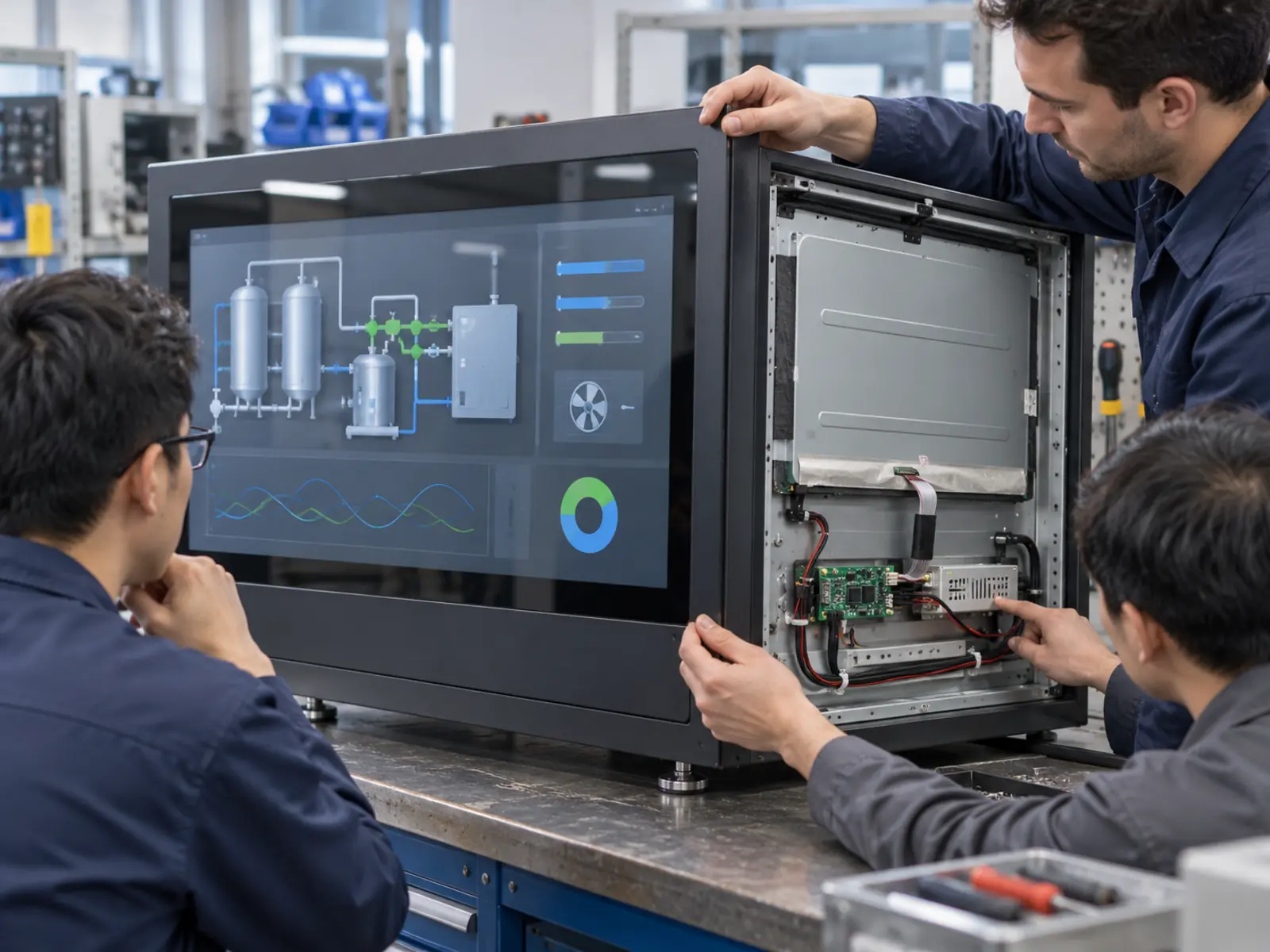
Separate close-range setup from normal production observation. Request the eye-to-screen distances, mounting height, tilt, lateral positions, and information needed at each position. Maintenance text may be read nearby while the machine-state indication must remain visible farther away.
Illustrative geometry: the same character viewed from 1.2 m has approximately half the angular height it has at 0.6 m. These are example distances, not recommended limits. Moving a larger screen farther behind a guard can reduce the expected readability benefit.
The reference's typical 178° viewing-angle figure uses a contrast-ratio threshold greater than 10. It does not establish readable text or reliable alarm-color recognition at every angle.
Claim: The required viewing positions and tasks must be recorded before the panel's readability can be accepted.
How Should Actual HMI Pages Release the Purchase?
What Should the Production-Page Test Include?
Use the production application, fonts, languages, and intended host. The preliminary reference shows 30-pin two-port LVDS, nominal 5 V panel power, and a separate six-pin backlight connection with an external LED driver. Confirm wiring, sequencing, and operating timing against the offered revision before energizing.
First verify native pixel mapping with single-pixel patterns and edge markers. Then display actual alarm lists, decimal values, units, trend labels, and the longest translated messages. Include ambiguous characters such as 0/O and 1/I wherever they occur in production content.
With the final cover and mounting, test representative operators at the marked positions under intended lighting. Record incorrect readings, requests to move closer, and obscured information. For PCAP-equipped samples, check that readable controls are also reachable and select the intended function.
Claim: Readability evidence must come from actual equipment pages and viewing conditions, not a full-screen demonstration image.
Which Results Should Change the Purchasing Decision?
Agree the required fields, observers, lighting states, permitted reading errors, and any task-time limits before testing. The OEM should set these criteria from its operating needs; no universal distance makes every FHD page acceptable.
If only distant status fails, enlarge or simplify that information and retest. If dense inspection detail fails nearby, compare a higher-resolution candidate with revised software scaling. If reflections hide values, review cover treatment, lighting, or mounting before assuming more backlight output will solve the problem.
Retain page identifiers, software and scaling settings, assembly configuration, viewing positions, and results as order-acceptance records. Recheck affected tasks after changes.
Claim: Purchasing should follow task-specific acceptance results, including any layout or assembly changes required to pass.
What Advantages Does XIANHENG Offer for LM270WF7-SLA1 Readability Qualification?
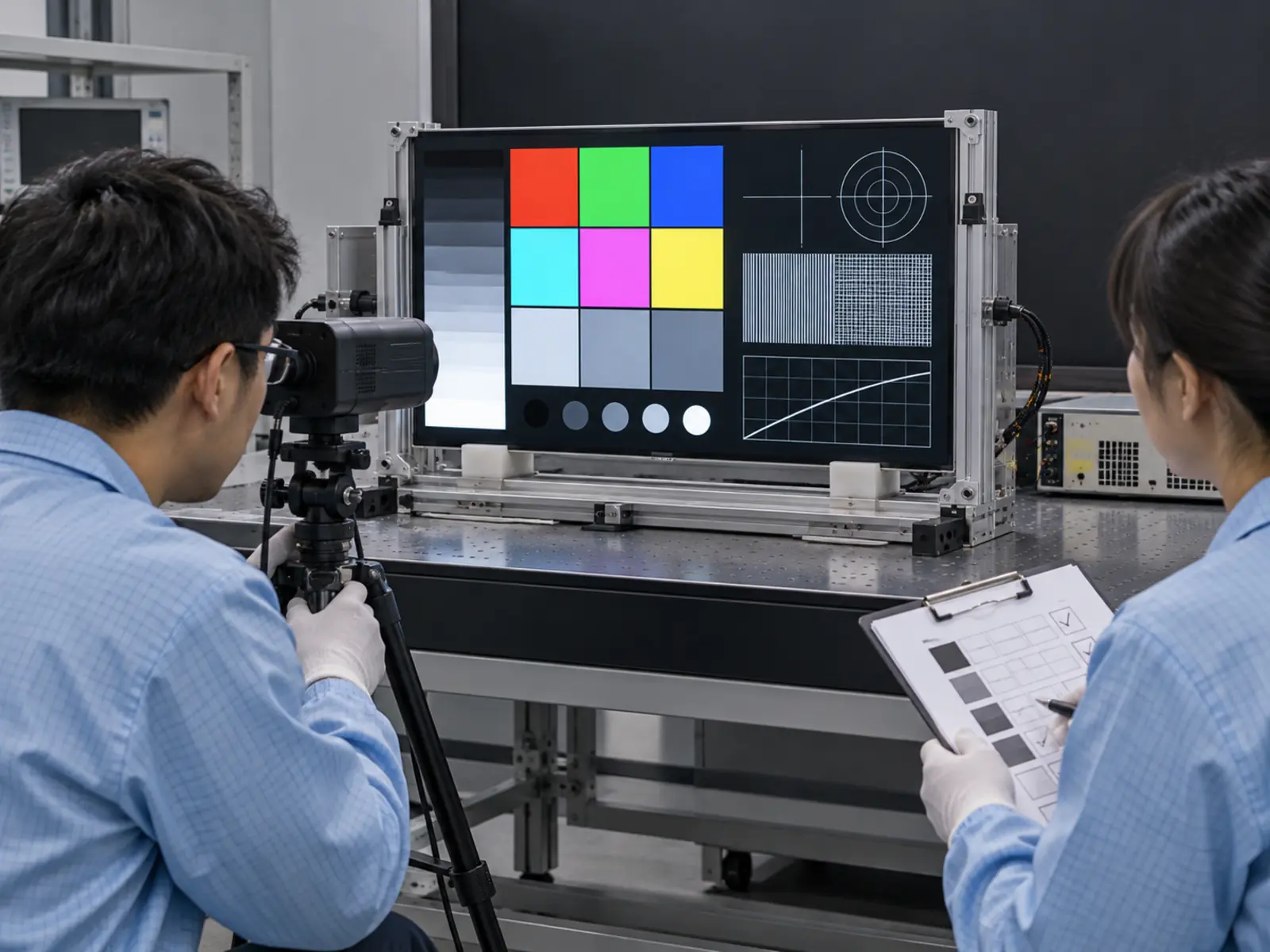
XIANHENG can review the LG Display LM270WF7-SLA1 27.0 Inch FHD IPS LCD Panel with HMI screenshots, measured character sizes, installation drawings, and observation positions to define a sample configuration.
The bare LCD excludes touch. Custom PCAP, printed cover glass, surface treatments, and bonding can be assessed around the viewing and interaction requirements. The preliminary standard reference gives 300 cd/m² typical center-white luminance under specified laboratory conditions, not final cover-stack brightness.
Selected models may be assessed for 500–1000 cd/m² customization or special higher targets. SLA1 feasibility requires confirmation, including driver, power, thermal, and optical-stack checks. This does not establish wide-temperature suitability or equipment certification.
Provide target brightness, installation conditions, touch requirements, and quantities. Browse the Industrial LCD Product Collection or reach out to XIANHENG to discuss a sample scope.
Claim: XIANHENG can help define the display sample; the OEM must approve readability in its equipment.


